GEOTECHNICALENGINEERING
RICHMOND HILL
HomeLaboratoryAtterberg limits

Atterberg Limits Testing in Richmond Hill: Clay Sensitivity and Bearing Performance

Evidence-based design. Reliable delivery.

LEARN MORE

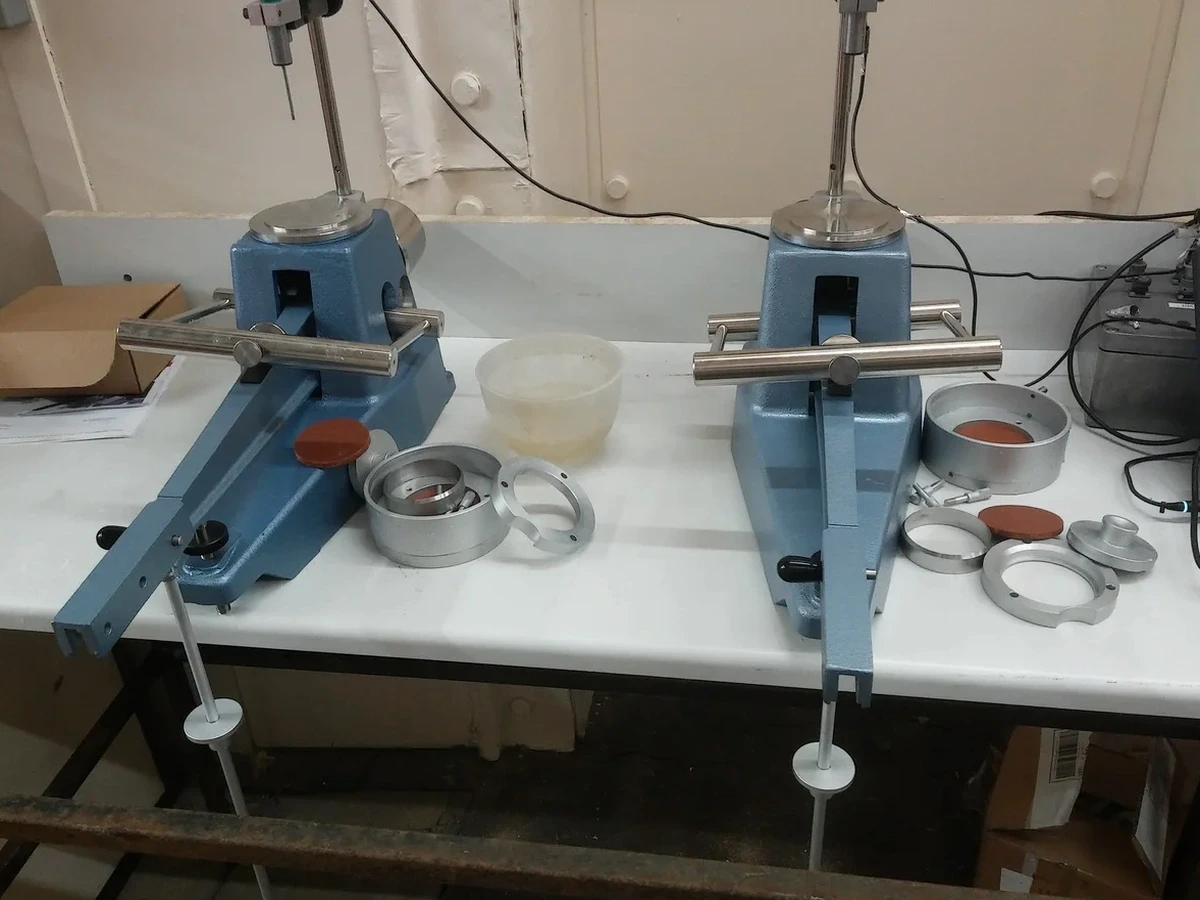
A common mistake on Richmond Hill jobsites is assuming that a stiff clay during summer excavation will behave the same way after a wet October. The difference comes down to Atterberg limits. When the water content crosses the plastic limit, even a competent-looking till loses bearing capacity fast. We run the full suite—liquid limit with the Casagrande cup, plastic limit by the 3 mm thread method, and the plasticity index—to give the geotechnical engineer the numbers needed before footing design. The grain-size distribution and the Atterberg limits together define the Unified Soil Classification, and without both, the NBCC Part 4 bearing pressure assumptions become a gamble. In the Halton Till that underlies much of Richmond Hill, we routinely see intermediate-plasticity clays where a small shift in moisture can trigger serviceability problems in shallow foundations.

A plasticity index above 25 in Richmond Hill glaciolacustrine clay almost always means we need to control moisture during compaction or switch to a deeper bearing stratum.

Our service areas

Methodology and scope

Richmond Hill sits at roughly 233 m above sea level on the Oak Ridges Moraine, but the surficial geology changes rapidly within a few blocks. North of Major Mackenzie Drive, the till is often sandier and the plasticity index drops below 12; south toward the Lake Iroquois Plain, we encounter glaciolacustrine clays where the liquid limit can exceed 50. That spread means the same structural design will perform differently depending on the lot. Our lab follows ASTM D4318-17ε1 for the multipoint liquid limit method, and we report the plasticity chart classification so the footings designer knows immediately whether the material is CL, CH, or something transitional. When the clay fraction is high, we also recommend the triaxial shear test to confirm the drained strength parameters, because the plasticity index alone cannot predict how the soil will behave under sustained load.
Atterberg Limits Testing in Richmond Hill: Clay Sensitivity and Bearing Performance
Technical reference — Richmond Hill

Local geotechnical context

The contrast between the west side of Yonge Street near the moraine crest and the lower-lying areas east of Bayview Avenue illustrates the risk. In the higher terrain, you get lean clays with moderate swell potential. Downslope, where the water table sits closer to grade, the same clay unit shows a higher liquid limit and a bigger shrink-swell envelope. A footing sized for the upper till can experience differential movement if the contractor hits the lower unit without adjusting the design. The Atterberg limits test gives us that early warning. We also use it to screen for frost susceptibility: a PI above 15 in a silt-clay mix under a rigid pavement section in Richmond Hill means the rigid-pavement subgrade needs a thicker granular base or a geotextile separator. Skipping the test and relying on visual classification alone leads to overexcavation costs that no one wants to explain to the owner.

Need a geotechnical assessment?

Reply within 24h.

Email: info@geotechnicalengineering.co

Applicable standards

ASTM D4318-17ε1 (Standard Test Methods for Liquid Limit, Plastic Limit, and Plasticity Index of Soils), NBCC 2020 Part 4 (Structural Design – geotechnical site investigation requirements), CSA A23.3 (Design of concrete structures – reference to bearing capacity on classified soils)

Reference parameters

ParameterTypical value
Liquid Limit (LL)Reported to nearest whole number per ASTM D4318
Plastic Limit (PL)Average of three 3 mm thread determinations
Plasticity Index (PI)PI = LL – PL, reported to nearest whole number
USCS ClassificationDerived from Atterberg limits and grain size curve
Sample PreparationOven-dried, sieved through No. 40 (425 μm)
Turnaround2–3 business days standard; same-day available on request
ReportingPlasticity chart with A-line and U-line plotted

Common questions

What does a high plasticity index mean for a Richmond Hill foundation?

A PI above 20 indicates a clay that is sensitive to moisture changes. In the glaciolacustrine deposits south of Richmond Hill, a high PI means the soil will shrink when dry and swell when wet. We recommend moisture-conditioned backfill or extending the footing depth below the active zone to reduce movement.

How much does Atterberg limits testing cost in Richmond Hill?

For a standard set of liquid limit, plastic limit, and plasticity index on one sample, the cost ranges between CA$100 and CA$140. If you bundle it with a grain size analysis and moisture content, we can reduce the per-sample rate. Call us with the number of samples and we will give you a fixed quote same day.

Can you run the test on a sample we already have in the office?

Yes, as long as the sample is sealed and has not dried out. We need about 150 grams of material passing the No. 40 sieve. We can pick up the sample from your Richmond Hill site or you can drop it at our receiving window. Results go out by email within two business days.

Location and service area

We serve projects in Richmond Hill and surrounding areas.

View larger map