GEOTECHNICALENGINEERING
RICHMOND HILL
HomeSeismicBase isolation seismic design

Base Isolator Engineering & Seismic Isolation Design in Richmond Hill

Evidence-based design. Reliable delivery.

LEARN MORE

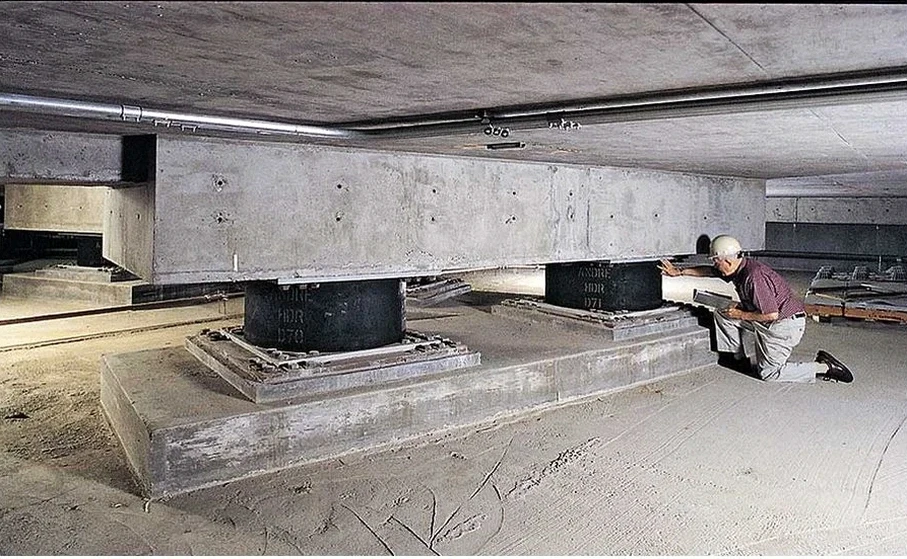
A mid-rise condo project near Yonge Street and a custom home backing onto the Oak Ridges Moraine face very different seismic demands in Richmond Hill, even though they sit just a few kilometers apart. The high-rise on dense till north of Major Mackenzie Drive responds to short-period acceleration, while the low-rise on the softer silty deposits near Lake Wilcox sees longer-period amplification. That contrast shapes how we approach base isolation design for each structure. Rather than stiffening the frame to resist lateral force, we insert a flexible layer between the foundation and the superstructure, using lead-rubber or high-damping elastomeric isolators that shift the building’s period away from the dominant energy of the ground motion. For sites with deep clay pockets, we often pair the isolation system with a mat foundation to provide a rigid base that keeps all isolators moving in phase, and we use CPT soundings to map impedance boundaries that could amplify vertical acceleration.

An isolation layer cuts spectral acceleration demand by 50 to 70 percent, turning a structural challenge into a predictable component specification.

Our service areas

Methodology and scope

Richmond Hill sits roughly 240 meters above sea level on the south slope of the Oak Ridges Moraine, a glacial landform that deposited interlayered till, sand, and silt across the municipality. The 2010 Val-des-Bois earthquake, while centered in Quebec, produced felt shaking here strong enough to crack drywall in several low-rise commercial buildings near Highway 7, reminding owners that intraplate seismicity is not a west-coast-only concern. Our isolation designs target two performance levels: immediate occupancy after the 475-year return event and collapse prevention at the 2,475-year level, per NBCC 2020 requirements. We size lead cores to provide both energy dissipation against wind service loads and hysteretic damping during the design earthquake, keeping residual drift below 0.2 percent of story height. The design loop always includes verification of isolator stability under maximum considered earthquake displacement, factoring in the aging and scragging effects on elastomer stiffness documented by Kelly and Konstantinidis.
Base Isolator Engineering & Seismic Isolation Design in Richmond Hill
Technical reference — Richmond Hill

Local geotechnical context

A six-story medical office building on Yonge Street sat on 18 meters of compressible silt with a water table less than 3 meters below grade. The conventional fixed-base design called for 900 mm drilled shafts socketed into till, with a schedule that stretched beyond 14 months just for the substructure. When we re-ran the response spectrum analysis with lead-rubber isolators at grade, the base shear dropped 62 percent, the foundation demand fell to spread footings on compacted fill, and the construction calendar shrank by four months. The real risk in Richmond Hill is not peak ground acceleration alone—it is the combination of soft soil amplification and a short stiff building period that locks the structure onto the site’s resonant frequency. Miss that interplay, and you are designing for forces that are 2 to 3 times higher than necessary, driving cost into every beam and column above grade.

Need a geotechnical assessment?

Reply within 24h.

Email: info@geotechnicalengineering.co

Watch the video

Applicable standards

NBCC 2020 Part 4 – Structural Design, Division B, CSA S832-14 – Seismic risk reduction of operational and functional components in buildings, CSA A23.3:19 – Design of concrete structures, ASTM D4014 – Standard specification for plain and steel-laminated elastomeric bearings, ISO 22762 – Elastomeric seismic-protection isolators

Reference parameters

ParameterTypical value
Design spectral acceleration Sa(0.2s)0.55–0.72 g (varies by site class within Richmond Hill)
Design spectral acceleration Sa(1.0s)0.19–0.28 g
Site class range (NBCC 2020)C (dense till) to E (soft silt near watercourses)
Target isolated period2.0–3.5 s depending on building height and soil profile
Isolator types evaluatedLead-rubber bearing (LRB), high-damping rubber (HDR), friction pendulum
Minimum isolator displacement capacity1.2 × DBE displacement per CSA S832-14
Required moat clearanceDisplacement + 25 mm minimum, verified for MCE
Wind restraint checkIsolator yield force ≥ 2.0 × design wind base shear

Common questions

What does a seismic base isolation design package cost for a building in Richmond Hill?

For a mid-rise structure in Richmond Hill, the isolation design package including hazard analysis, isolator specification, and construction drawings typically ranges from CA$6,020 to CA$9,950, depending on building complexity and the number of ground motion records required for time-history analysis.

How does base isolation affect the foundation type required in Richmond Hill?

Because base isolation reduces seismic forces transmitted to the foundation, it often allows lighter foundation systems. A fixed-base design might require deep piles, while the isolated version may only need a rigid mat slab or spread footings, provided the mat provides sufficient stiffness to keep all isolators moving uniformly.

Which buildings in Richmond Hill benefit most from seismic isolation?

Essential facilities like hospitals, data centers, and emergency operations centers benefit because they must remain functional after a large earthquake. High-value commercial buildings and condominiums on soft soil sites—such as those near the Rouge River floodplain—also see significant cost savings when isolation cuts the structural demand.

What testing is required before isolators are installed on a Richmond Hill project?

We require prototype testing of two full-scale isolators per type, per ISO 22762, including vertical load capacity, horizontal stiffness at multiple displacement levels, and aging and scragging characterization. Production testing then covers every isolator for compression stiffness and shear properties before shipment to the site.

Location and service area

We serve projects in Richmond Hill and surrounding areas.

View larger map